Intense emotions, inner tension, impulsivity, and difficulties in interpersonal relationships can make everyday life with Borderline Personality Disorder (BPD) very challenging. Especially during emotional crises, it can be difficult to pause and find a helpful response.
This is precisely where skills come in. Skills are learned strategies that can help manage intense emotions, tension, stress, impulses, or difficult situations. Skills from Dialectical Behavior Therapy (DBT) by Marsha M. Linehan are particularly well-known.
DBT was originally developed for people with Borderline Personality Disorder. Today, it is also used for other mental illnesses and problems where difficulties with emotion regulation play a central role, such as complex PTSD. [1] [2]
On this page, you will find understandable information on:
What is Borderline?
Borderline Personality Disorder (BPD) is a mental illness that can be characterized by difficulties in regulating emotions, an unstable self-image, interpersonal problems, and impulsivity. The manifestation varies greatly individually. Not every person with Borderline experiences the same symptoms or with the same intensity.
Typical characteristics can include:
- intense and rapidly changing emotions
-
difficulties regulating strong feelings (e.g., frequent outbursts of anger)
- pronounced fear of rejection or abandonment
- unstable or conflict-ridden interpersonal relationships
- a fluctuating or insecure self-image
- impulsivity in at least two potentially self-damaging areas (e.g., spending money, sex, substance abuse).
- severe inner tension
-
feelings of emptiness
-
recurrent suicidal thoughts, attempts, or gestures, or self-harming behavior
According to the DSM-IV, at least five of the described characteristics must be met for a Borderline disorder. [1] [2]
Borderline and Emotion Regulation
A central component of Borderline Personality Disorder is difficulties with emotion regulation. For many affected individuals, emotions can arise particularly quickly and intensely. This can mean, for example:
- It takes a long time for emotional arousal to subside.
- Small triggers can provoke strong reactions.
- After a conflict, it's hard to calm down again.
- Impulses can be difficult to control in emotional situations.
This does not mean that the feelings are "exaggerated" or "not real." The emotional reaction is real. The challenge often lies in dealing with their intensity.
Precisely at this point, skills from Dialectical Behavior Therapy (DBT) can be applied: They are intended to create an alternative way to deal with high tension and intense emotions.
What are Skills?
Skills are learned strategies for self-regulation. They can help to perceive an emotional state, create a pause between impulse and action, and get through a situation as safely as possible. Depending on the situation, the following things can be helpful:
- conscious breathing
-
directing attention to a strong sensory stimulus
- feeling an object
- perceiving cold or warm water
- moving
-
listening to music
-
writing down thoughts
Which skills work is individual. A skill that helps one person may be uncomfortable or completely ineffective for another.
The Four Areas of DBT Skills
In Dialectical Behavior Therapy, skills are often assigned to four main areas:
1. Mindfulness
- consciously perceiving five things in the room
- observing sounds
- feeling the contact of the feet with the ground
- observing the breath
- noticing thoughts without immediately reacting to them
The goal is not to make unpleasant feelings disappear immediately. Rather, it is about perceiving them without automatically acting on the first impulse.
2. Distress Tolerance
Distress tolerance skills can be particularly useful in acute situations where emotional tension is very high. The goal is to endure a difficult situation without harming oneself or others.
Possible skills include:
- intense but safe physical exercise (e.g., jumping jacks, sprinting in place)
- conscious perception of sensory stimuli
- music
- breathing exercises
- a fidget item
- distraction through a specific activity
- contact with a trusted person
- temporarily withdrawing from a stressful situation
Especially when tension is very high, simple and readily available skills can be helpful.
3. Emotion Regulation
Emotion regulation skills focus more on one's own feelings and their triggers. This involves, for example:
- better recognizing feelings
- understanding emotional triggers
- perceiving needs
-
developing helpful behaviors
4. Interpersonal Effectiveness
Borderline can make relationships particularly challenging. Affected individuals may feel alienated, lonely, or misunderstood. Interpersonal skills help, for example, with:
- expressing one's own needs
- setting boundaries
- saying "no"
- managing conflicts more constructively
- maintaining relationships
- not losing sight of one's goals in a conversation
Skills for Different Levels of Tension
When emotional tension is very high, thinking and decision-making can become significantly more difficult. A helpful approach, therefore, is not to wait until a crisis to search for a suitable skill. Instead, it can be useful to put together a personal skills collection, skills bag, or emergency kit beforehand. The emergency kit should consist of no more than three to four skills. Here is an overview of skills for different levels of tension:
For mild to moderate tension
- Observe and describe emotions, e.g., what triggered the tension? What are my thoughts? What do I feel in my body? What am I feeling?
- listen to music
- go for a walk
- play with a fidget toy
- favorite snack
- drink tea
- call someone
- Breathing exercises
For very high tension (High-Stress Skills with strong sensory stimuli through our five senses)
- run cold water over your face
- hold ice cubes in your hand or mouth
- roll a massage ball (spiky ball) over your arms
- tap your entire body
- chew gum (Centershock, Airwaves)
- smell essential oils (e.g., Tiger Balm)
-
flick a rubber band on your wrist
-
strenuous exercises, e.g., wall sits, jumping jacks, burpees, push-ups
Fidget Toys as Sensory Distraction
Sensory stimuli can be used to direct attention or interrupt an emotionally charged moment. Fidget Toys can provide such controllable, body-friendly, sensory stimuli:
- Spinning & Rotating: Fidget Rings
- Squeezing & Pulling: Stress balls, squishies, squeeze toys, playdough, Fidget Tangle
- Clicking: Fidget Clicker, keyboard fidget
- Touching & Feeling: Spiky balls, acupressure rings, acupressure chips, texture fidgets
- Chewing & Biting: Chew sticks and special chew toys
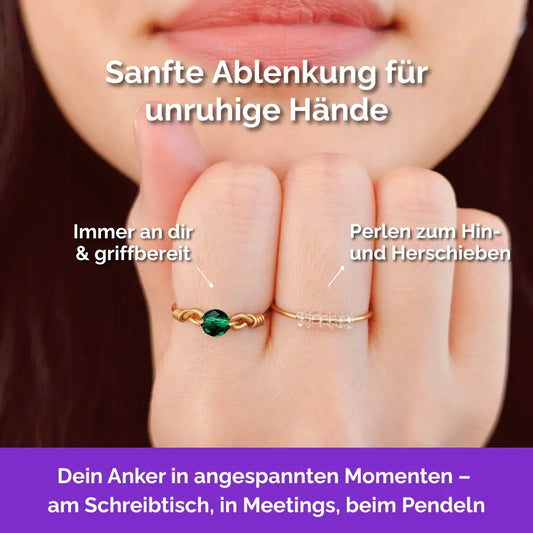
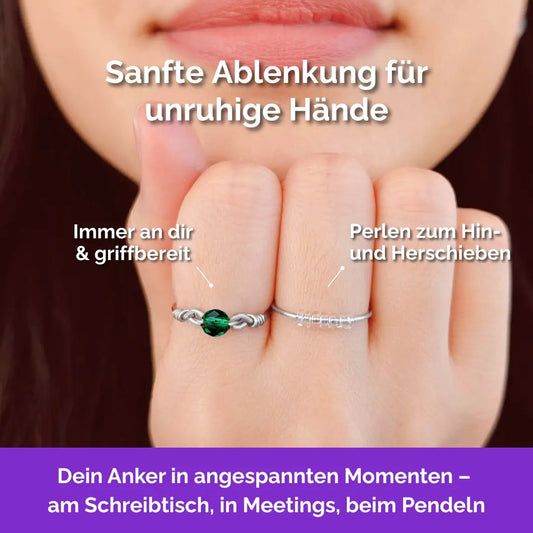
A fidget ring can be particularly practical because it is immediately available. For example, it can be discreetly spun or moved on a finger. This can be especially practical in everyday life:
- at work
- in conversations
- on the go
- while waiting
- while watching TV
- in stressful situations
An elastic fidget bracelet can also be a practical way to integrate sensory stimuli into daily life. It can be worn directly on the wrist and can be felt or flicked for a slight pain stimulus when needed.
Skills work best when they are not first tried out in the midst of the biggest crisis. You can test different strategies first in situations with lower tension and find out: What works for me?
Further Resources & Book Recommendations
Note: Some links on this page lead to external websites. These are unpaid recommendations for which I receive no compensation.
- DBT-Skillstraining: Das Patienten-Manual - Martin Bohus
- Stronger Than Borderline: How to Control Your Emotional Chaos - Debbie Corso
- Extremely Feeling: My Terribly Beautiful Life with Borderline - Joelle Westerfeld
- The World of Women and Girls with Borderline: How They Find Stability in a Life Between Extremes - Matthies & Janzarik
- I Hate You – Don’t Leave Me: The Black and White World of Borderline Personality - Kreisman & Straus
Sources
[1] Bohus, Martin (2024): DBT-Skillstraining: Das Patienten-Manual. Schattauer, 4th reprint, 464 pages, ISBN 978-3-608-40193-6.
[2] Kreisman, Jerold J. & Straus, Hal (2012): I Hate You – Don’t Leave Me: The Black and White World of Borderline Personality. Kösel, 3rd edition, 416 pages, ISBN 978-3-466-34784-1